Precious metals storefront

113.6M ₽
Bars revenue in 2 months
102M ₽
Coins revenue in 2 months
9,652 g
Bars sold, 40% from website
733
Coins sold, 40% from website
Impact
113.6M ₽
Bars revenue in 2 months
102M ₽
Coins revenue in 2 months
9,652 g
Bars sold, 40% from website
733
Coins sold, 40% from website
In 2022, Russia abolished the 20% VAT on retail sales of precious metal bars, making gold and silver accessible investment instruments for the mass market. By 2025, precious metals had become one of the top-performing asset classes, with major banks competing for retail market share. Alfa-Bank had the demand — but no digital channel to capture it.
Context
In 2022, Russia abolished the 20% VAT on retail sales of precious metal bars, making gold and silver accessible investment instruments for the mass market. By 2025, precious metals had become one of the top-performing asset classes, with major banks competing for retail market share. Alfa-Bank had the demand — but no digital channel to capture it.
Problem
Without a digital storefront, all precious metals sales depended entirely on branch visits and unstructured phone inquiries. Customers had no way to browse inventory, compare products, or express clear purchase intent online. Precious metal prices update daily in line with Central Bank rates — any static content would be outdated within hours.
Constraints
The project launched under real pressure: a new Product Owner joined in July, the team inherited the project in August, and the goal was to ship to production within the same quarter. The decision was made to launch an MVP first — built on existing design system components, without custom dev work or user testing cycles.
What it does
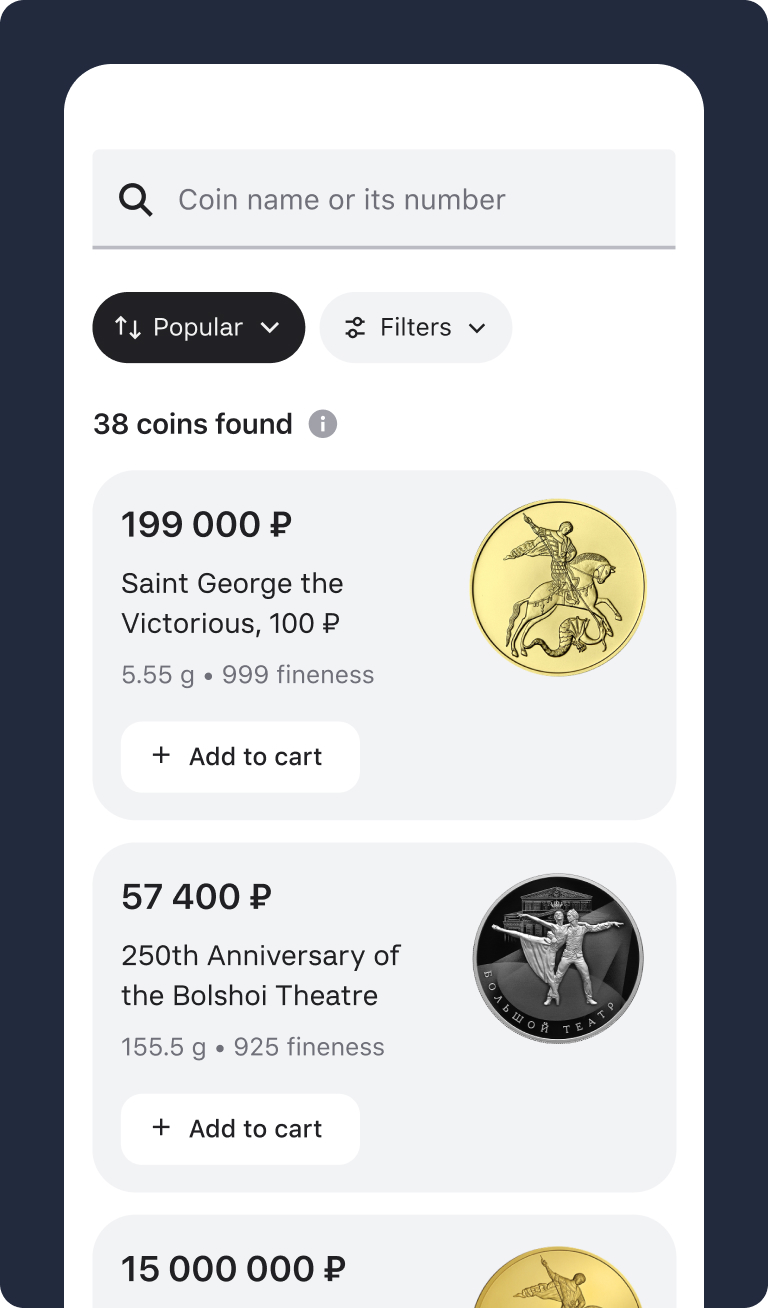
Step 1: customer browses the coin catalog with filtering and sorting options. They can open a product card to explore full details — metal type, weight, mintage, price — and add items to the cart from the card or directly from the catalog. Quantity is adjustable at both points
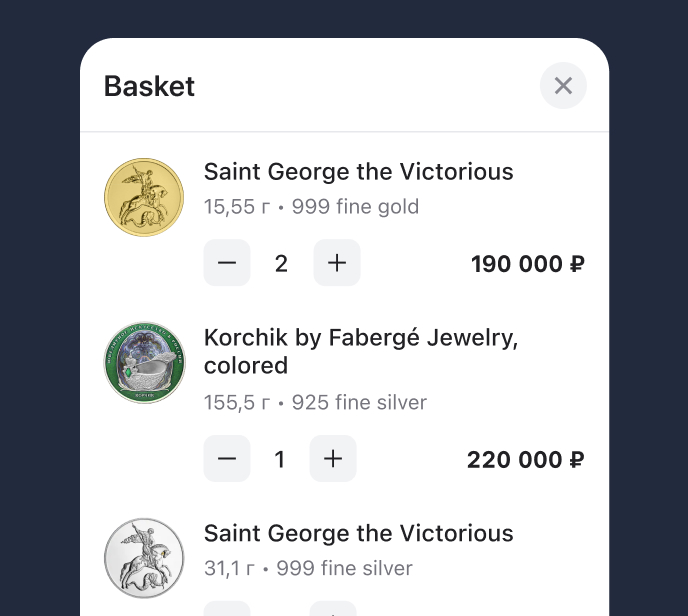
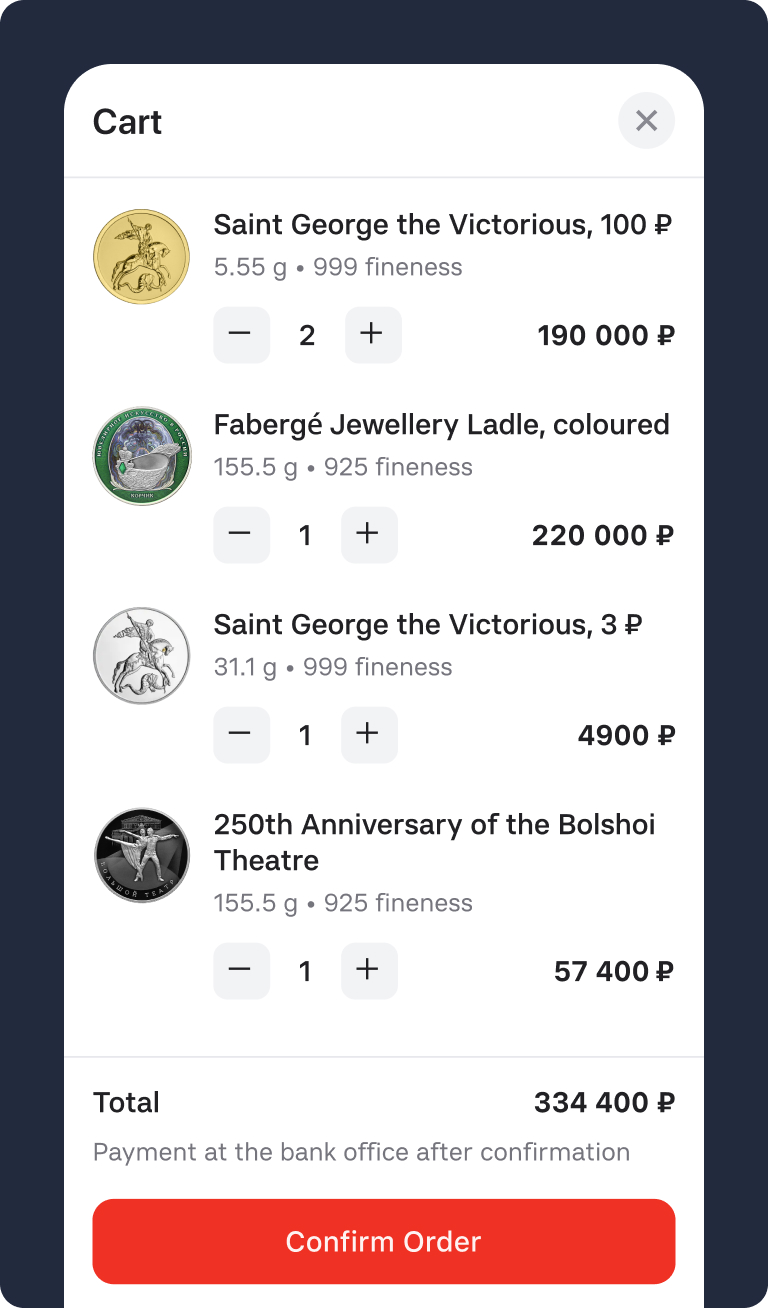
Step 2: a sticky cart button gives constant access from anywhere in the flow. Inside the cart, customers review their selection, adjust quantities, or remove items. Deleted products are held on screen for 5 seconds with an undo option — recovering from accidental taps
Step 3: customer fills in contact details — name, phone, city — and submits an application. A bank manager calls back to confirm and arrange the purchase. Physical coins are handed over in person at a branch or via delivery, coordinated by the manager after the application is received
My process
Discovery — researched Storybook component library, analyzed competitor storefronts, collected references, discussed technical constraints with frontend developers and the website design team.
Information architecture & UX — mapped the user journey and information architecture. Defined the core flow: landing page → product catalog → cart → lead form → success state. The key design challenge: making a cart-to-lead-form flow feel complete and trustworthy without an actual checkout.
Hypothesis-driven design — framed the cart feature around a clear product hypothesis: users who can build a structured order before submitting a request will convert at a higher rate and generate higher-quality leads. Defined success metrics upfront: conversion from catalog sessions to submitted requests, average number of items per order, share of multi-item submissions.
Delivery — produced full annotated mockups, presented to stakeholders, ran design reviews, led grooming sessions, wrote specs for implementation, reviewed the built solution before launch.
Solution
The storefront consists of three connected surfaces. Category landing page introduces precious metals as an investment product and routes users to bars or coins. Product catalog supports filtering, sorting, search, and pagination across 38+ SKUs with automatic price updates via Central Bank integration. Cart + lead form flow lets users add products with quantity controls, review in a modal overlay, then submit a structured request with name, phone, and preferred city.
Impact
Launched 2 fully functional storefronts from zero in 2 months.
Created a new digital sales channel: structured lead → telemarketing call → branch purchase.
Telemarketing efficiency improved: agents receive specific product lists instead of vague verbal requests.
+10% conversion from catalog sessions to submitted requests